Strut

The beauty of the Egyptian goose is sometimes taken for granted, thanks to its proliferation all over South Africa, and stretching right up to the north of the African continent. It is endemic to the Nile Valley and the entire area south of the Sahara Desert. The Egyptian Goose is related to the shelduck and is a cross between a duck and a goose. The Egyptian goose has vivid markings that are striking and impressive. In fact, they were considered to be holy by the Egyptians, who often included them in works of art due to their undeniable beauty. This bird is pale brown and grey, with rich brown or chestnut markings around the eyes, around the neck (resembling a collar), on a portion of the wings, and under the otherwise black tail. In stark contrast, there are crisp white markings on the wings, complemented by an intense emerald on the secondary feathers of the males. There is also a well-defined brown patch right in the centre of the chest. The female of the species is slightly smaller than her male counterparts. Apart from this, there are few to no clear differences between the sexes.
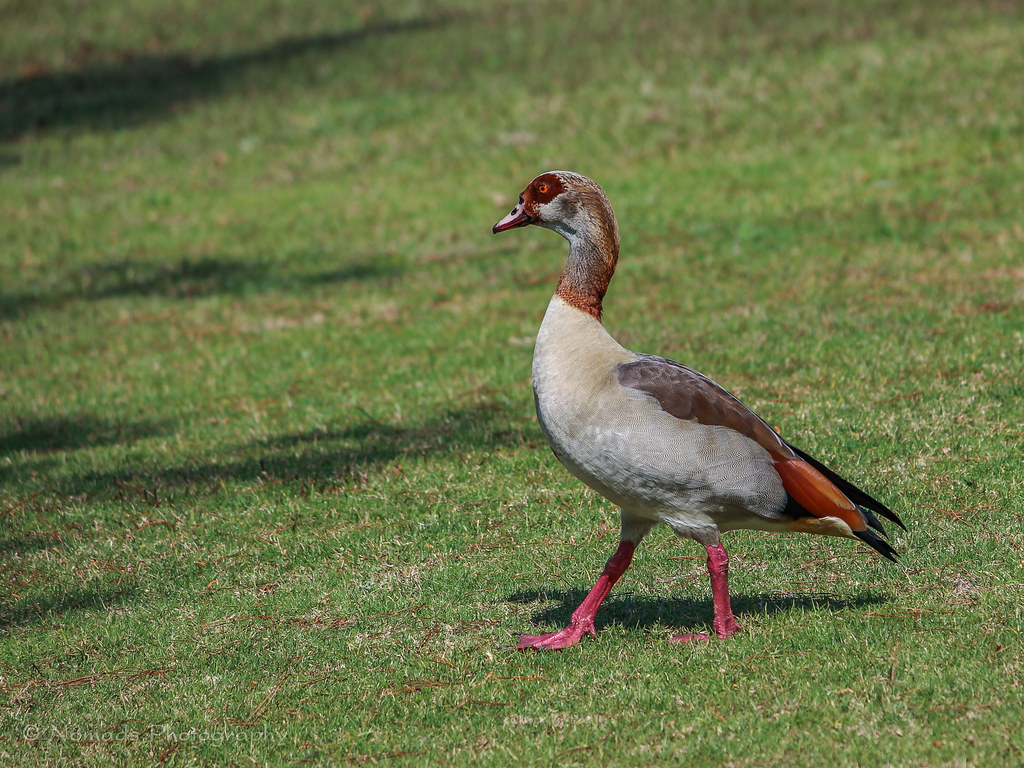
Strut

Kaleidoscope

Rollers get their name from their impressive courtship flight, a fast, shallow dive from considerable elevation with a rolling or fast rocking motion, accompanied by loud raucous calls. All rollers appear to be monogamous and highly territorial. The Lilac Breasted Roller will perch on a dead tree, surveying the area for prey. One typical aspect of its behaviour is that it also preys on animals fleeing from bushfires. It is a swift flier, indulging in acrobatics during the breeding season. They actually breed ‘on the wing’. They live in pairs or small groups but are often seen alone. Their call is a loud harsh squawk, ‘zaaak’. They are partly migratory, but in some areas they are sedentary. To feed they swoop down from an elevated perch next to their prey and eat it on the ground or return to a perch where they batter it before swallowing it whole. They are territorial, also defending temporarily small feeding territories; hence individuals are regularly spaced along roads. They drive off many species from near their nest hole, even after breeding.

Kaleidoscope

Disordered

The African Gray Hornbill prefers open woodland and savannah. The female lays two to four white eggs in a tree hollow, which is blocked off during incubation with a cement made of mud, droppings and fruit pulp. There is only one narrow aperture, just big enough for the male to transfer food to the mother and the chicks. When the chicks and female outgrow the nest, the mother breaks out and rebuilds the wall, after which both parents feed the chicks. The male has a black bill, whereas the female has red on the mandibles. The plumage of the male and female is similar. Immature birds are more uniformly grey. The flight is undulating. The similarly sized red-billed hornbill has uniformly grey plumage.
The African grey hornbill is omnivorous, taking insects, fruit and reptiles. It feeds mainly in trees.

Disordered