Annoyed

Hippotamus, plural Hippopotami or commonly named Hippos in South Africa are found mainly in protected areas, private game reserves and the Kruger National Park. They also occur outside of these areas especially in rivers in the northwestern, northern, northeastern as well as in the eastern parts (northern KwaZulu-Natal). Hippos need permanent open water like rivers, dams, or pools in rivers where they can submerge, with sandbanks where they can bask in the sun for periods of time. They also need enough grazing grass in the area. Hippos are semi-aquatic and gregarious animals. They gather or form pods of up to 30 animals or more depending on the water level and time of the season. Hippo pods consist mainly of cows and young hippos with a matriarch and a dominant (territorial) bull in control of the territory. Single bulls are also often found. Cows with very young calves often stay on their own for a few months before rejoining the pod. Hippos spend their days resting mainly in the water although in winter and on cool days might be resting on sandbanks and basking in the sun especially in winter months. They feed mainly at night.

Info source: http://www.wildlifesouthafrica.com/blog/mammals-of-south-africa/hippopotamus-hippo-fact-file

The photo was taken during January 2014 Mabula Private Game Reserve, Rooiberg, Limpopo, South Africa.

Annoyed

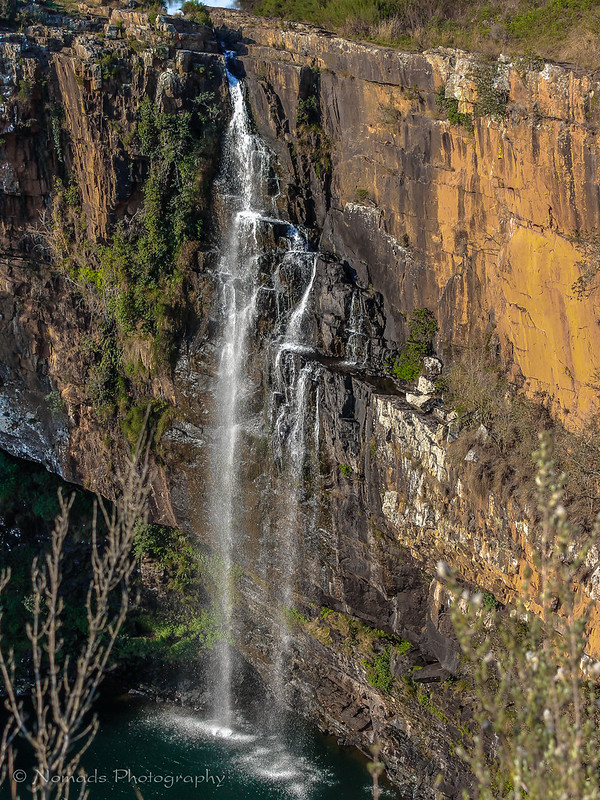
Candle

The Berlin Falls is a waterfall in Mpumalanga, South Africa. They are located close to God’s Window and the highest waterfall in South Africa’s Mpumalanga province, Lisbon Falls. The Berlin Falls cascade from the centre of a sheer cliff that stands roughly 80m tall. The shape of the falls is likened to a giant candle. A narrow, natural channel at the top of the falls creates the ‘wick’ of the candle, and as the water drops from this point, it fans out creating the rest of the candle before emptying out into the pool below. Berlin Falls gets its name from miners who ventured to South Africa from Europe during the gold rush and named each waterfall in the region after their home towns, or places from their home countries. The falls are on the Sabine River and fall 80 metres (260 ft), dumping into a circular basin flanked by red cliffs.
Info source: https://en.wikipedia.org/wiki/Berlin_Falls
=========
The photo was taken during August 2013 at Berlin falls, God’s Window, Mpumalanga, South Africa.

Candle

Scruffy

The hyena is a shaggy, untidy and opportunistic carnivore with a distinctive, sloping back. It weighs around 60 kg (males can be heavier) and stands about 80 cm at the shoulder. Almost all hyena in Kruger is the spotted hyena. They are found throughout Kruger and the best places to see them are south-west Okavango, Savuti and Linyanti. The brown hyena found in southern Africa’s more arid environments. The spotted hyena hunts and scavenges by night and is closely connected in African folklore with the supernatural world. Anyone who has heard the sound of hyenas in full cry around midnight would understand the animal’s association with the dark arts. Unlike the honest, authoritarian roar of the lion which resonates with purity and strength, the “laughing” hyena’s utterances are hysterical and mocking, an eerie human-like giggling shriek that would not be out of place in a mental asylum. It’s body parts command a premium price on the local muti market, particularly the tail, ears, whiskers, lips and genitals.
Info source: http://www.krugerpark.co.za/Kruger_National_Park_Wildlife-travel/kruger-park-wildlife-hyenas.html
=========
The photo was taken during September 2017 near Afsaal Picnic Spot, Kruger National Park, Mpumalanga, South Africa.

Scruffy