Strut

The beauty of the Egyptian goose is sometimes taken for granted, thanks to its proliferation all over South Africa, and stretching right up to the north of the African continent. It is endemic to the Nile Valley and the entire area south of the Sahara Desert. The Egyptian Goose is related to the shelduck and is a cross between a duck and a goose. The Egyptian goose has vivid markings that are striking and impressive. In fact, they were considered to be holy by the Egyptians, who often included them in works of art due to their undeniable beauty. This bird is pale brown and grey, with rich brown or chestnut markings around the eyes, around the neck (resembling a collar), on a portion of the wings, and under the otherwise black tail. In stark contrast, there are crisp white markings on the wings, complemented by an intense emerald on the secondary feathers of the males. There is also a well-defined brown patch right in the centre of the chest. The female of the species is slightly smaller than her male counterparts. Apart from this, there are few to no clear differences between the sexes.
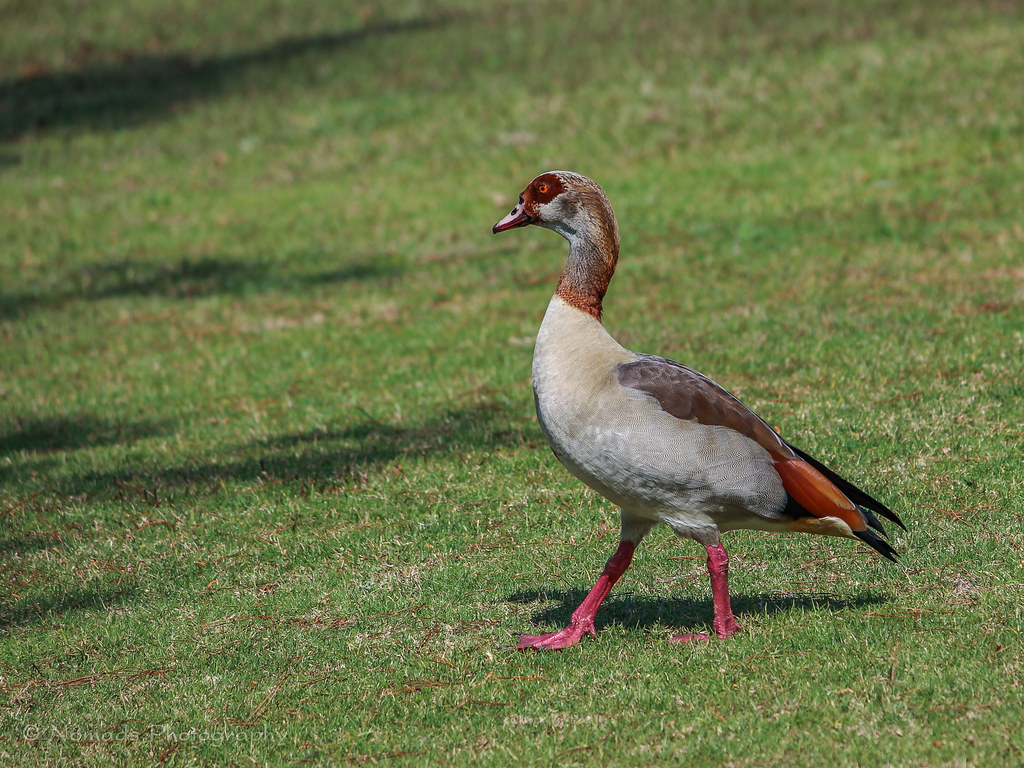
Strut

Burst

The common bulbul is usually seen in pairs or small groups. It is a conspicuous bird, which tends to sit at the top of a bush. As with other bulbuls they are active and noisy birds. The flight is bouncing and woodpecker-like. The call is a loud doctor-quick doctor-quick be-quick be-quick. This species nests throughout the year in the moist tropics, elsewhere it is a more seasonal breeder with a peak in breeding coinciding with the onset of the rainy season. The nest is fairly rigid, thick-walled, and cup-shaped. It is situated inside the leafy foliage of a small tree or shrub. Two or three eggs is a typical clutch. It, like other bulbuls, is parasitised by the Jacobin cuckoo. These species eat fruit, nectar, seeds and insects.

Burst

Halo

The crowned lapwing is easily recognized by its combination of brown and white colours, with most tellingly, a black crown intersected by an annular white halo. Adults are noisy and conspicuous. Crowned lapwings prefer short, dry grassland which may be overgrazed or burnt, but avoid mountains. In higher-rainfall areas such as parts of Zambia and Zimbabwe, they occur mainly as dry-season visitors. In dry regions of northern Botswana, however, they are attracted in large numbers when good rainfall occurs. In southern Africa, their highest concentrations are to be found in the dry central Kalahari region. Although generally outnumbered by blacksmith lapwings, they are the most widespread and locally the most numerous lapwing species in their area of distribution. Their numbers have increased in the latter part of the 20th century after benefiting from a range of human activities. They live up to 20 years.

Halo