Earlybirds

Umhlanga is a fun seaside town. The long beaches stretch into the distance, frequented all year by locals and visitors. The 2 main swimming beaches have lifesavers. There are pools in the rocky outcrops along the shore for families with children to paddle in. The main swimming beach is the Bronze beach. The efficient Sharks Board sends crews daily on ski boats to check the nets to ensure safe swimming. Their headquarters in Umhlanga Ridge have interesting audiovisual lectures daily. There is a strong water lifestyle culture. No wet suits are needed as the ocean is warm all year for surfing, swimming, scuba diving, kiteboarding, fishing and sailing. The winter is mild and brief, from June to August, and the rest of the year warm with a summer rainfall of evening showers. A wide paved Promenade curves for 3 kilometres along the beach overlooking the sea, frequented by runners and walkers all day until dark.
Info source: https://www.afristay.com/a/umhlanga/
=========
The photo was taken during June 2016 at Umhlanga Beach, Kwazulu-Natal, South Africa.

Earlybirds

Lifeguards

Llandudno Beach is one of the Cape’s most naturally diverse beaches, surrounded by large granite boulders and overlooked by mountains. It is a popular surfing spot, but the swimming can be treacherous, with rough seas and extremely cold water. Llandudno has lifeguards on duty during the summer season, operated by the Llandudno Surf Lifesaving club. It is also the access point for the walk to Sandy Bay, an isolated beach still popular with nudists. On 26 September 1903 the valley was declared a township and named Llandudno after the North Wales seaside resort of Llandudno, which means “Parish of Saint Tudno” in the Welsh language. The striking similarities between Kleinkommetjie Bay in which the valley resides and Llandudno in Wales were noted as reasons for choosing this name.
Info source: https://en.wikipedia.org/wiki/Llandudno,_Cape_Town
=========
The photo was taken during October 2014 at Llandudno, Western Cape, South Africa.

Lifeguards

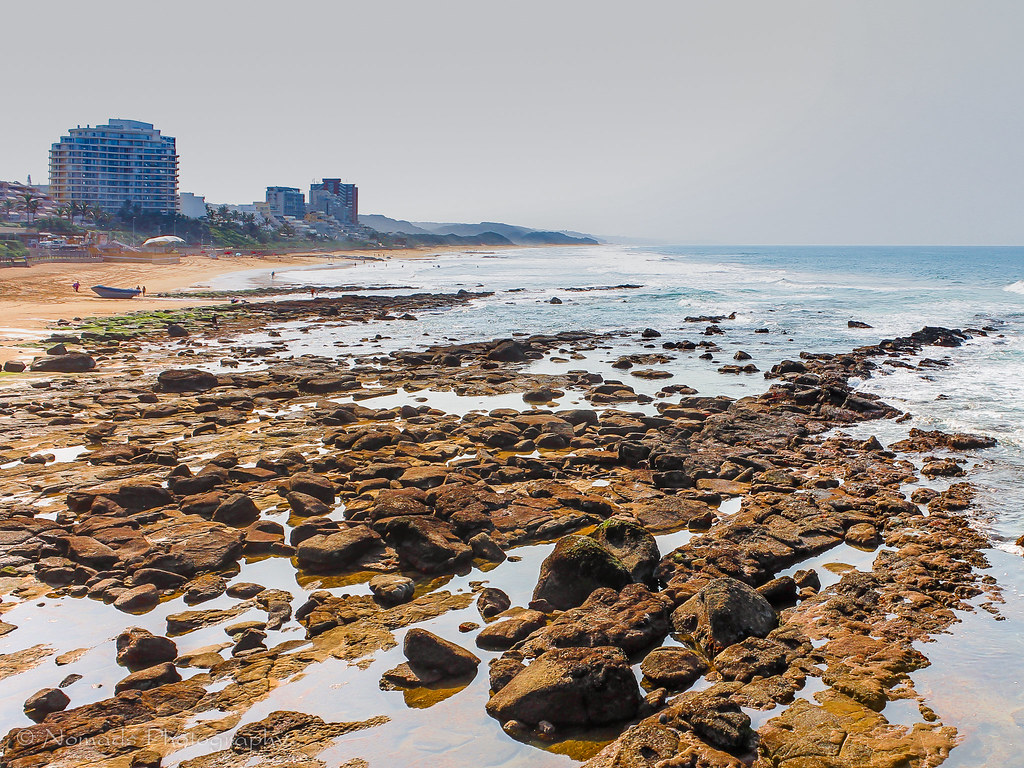
Retracted

Retracted
High and low tides are caused by the moon. The moon’s gravitational pull generates something called the tidal force. The tidal force causes Earth—and its water—to bulge out on the side closest to the moon and the side farthest from the moon. These bulges of water are high tides.
* One cycle of tides actually takes 24 hours and 50 minutes.
* The highest tides occur when the moon is new or full.
* High tides sometimes occur either before or after the moon is straight overhead.
* Sometimes there are really low tides called neap tides.
* Some places have only one high tide and one low tide in a cycle (24 hours and 50 minutes).
Info source: https://scijinks.gov/tides/
=========
The photo was taken during June 2014 at Cabana Beach Lifestyle Resort, Umhlanga Rocks, KwaZulu-Natal, South Africa.

Retracted