Candle

The Berlin Falls is a waterfall in Mpumalanga, South Africa. They are located close to God’s Window and the highest waterfall in South Africa’s Mpumalanga province, Lisbon Falls. The Berlin Falls cascade from the centre of a sheer cliff that stands roughly 80m tall. The shape of the falls is likened to a giant candle. A narrow, natural channel at the top of the falls creates the ‘wick’ of the candle, and as the water drops from this point, it fans out creating the rest of the candle before emptying out into the pool below. Berlin Falls gets its name from miners who ventured to South Africa from Europe during the gold rush and named each waterfall in the region after their home towns, or places from their home countries. The falls are on the Sabine River and fall 80 metres (260 ft), dumping into a circular basin flanked by red cliffs.
Info source: https://en.wikipedia.org/wiki/Berlin_Falls
=========
The photo was taken during August 2013 at Berlin falls, God’s Window, Mpumalanga, South Africa.
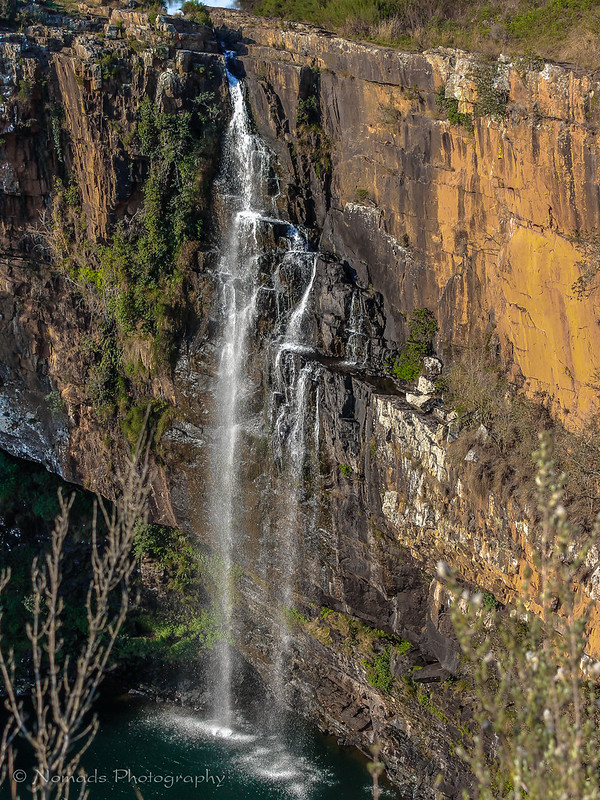
Candle

Trilogy

The giraffe is the tallest mammal in the world, standing at around 4-5m high, and the tallest giraffes ever recorded have been up to 5.9m. That’s over a meter higher than a double-decker bus. It shouldn’t come as a huge surprise that such a large animal weighs quite a lot as well – up to 1900kg, which is more than most cars! A giraffe’s neck is too short to reach the ground. As a result, it has to awkwardly shuffle and spread its front legs to reach the ground for a drink of water. Fortunately, giraffes only need to drink once every few days, as they can get most of their water from all the plants they eat. Despite being incredibly tall, giraffes still only have seven vertebrae in their necks – which means a giraffe neck has the exact same number of bones as a human neck! A fully grown giraffe can raise or lower its head by up to 5m, so it might actually pass out were it not for a dense network of fine capillaries (the ‘rete mirabile’) that cushions its brain against rapid changes in blood pressure. Other adaptations to prevent sudden giraffe collapse are valves to stop the back-flow of blood and elastic-walled vessels that dilate and constrict to manage the flow.
Info source: https://www.discoverwildlife.com/animal-facts/mammals/facts-about-giraffes/
=========
The photo was taken during September 2017 near Lower Sabie, Kruger National Park, Mpumalanga, South Africa.

Trilogy

Ripples

Robberg Nature Reserve, situated 8km south of Plettenberg Bay on the Garden Route, is not only a nature reserve but also a national monument. Rocks from this region date back 120 million years to the break-up of Gondwanaland and evidence of middle and later Stone Age inhabitation has been found in a few of the caves along the peninsula. Visitors can find out more at the Nelson Bay Cave interpretive centre. Some highlight features of a visit here include spotting the rare blue duiker, the Western Cape’s smallest antelope; walking alongside one of the seven climbing-falling dunes on the Cape coastline; and viewing the highest navigational light on the South African coastline, at the Cape Seal Lighthouse (146m above sea level). The reserve also extends 1.8km offshore, providing protection to a range of vulnerable fish species. Visitors can expect inspiring landscapes, exciting dolphin and whale sightings in season, and to be accompanied on their walks or hikes by a variety of bird species and the occasional seal. An overnight hut is available for those who want to spend more time on this beautiful reserve.
Info source: https://www.plett-tourism.co.za/activity/robberg-nature-reserve/
=========
The photo was taken during October 2016 at Robberg Nature Reserve, Plettenberg Bay, Western Cape, South Africa.

Ripples