Flurry

The African fish eagle feeds mainly on fish, which it swoops down upon from a perch in a tree, snatching the prey from the water with its large, clawed talons. The eagle then flies back to its perch to eat its catch. Like other sea eagles, the African fish eagle has structures on its toes called spicules that allow it to grasp fish and other slippery prey. The osprey, a winter visitor to Africa, also has this adaptation. Should the African fish eagle catch prey over ten times their own body weight, it is too heavy to allow the eagle to get lift, so it instead drags the fish across the surface of the water until it reaches the shore. If it catches a fish too heavy to allow the eagle to sustain flight, it will drop into the water and paddle to the nearest shore with its wings. The African fish eagle is known to steal the catch of other bird species (such as goliath herons) in a behaviour known as kleptoparasitism. It also feeds on birds especially waterbirds such as ducks, greater and lesser flamingos, small turtles and terrapins, baby crocodiles, lizards, frogs, and carrion. Occasionally, it may even carry off mammalian prey, such as hyraxes and monkeys. It has also been observed feeding on domestic fowl (chickens).
Info source: https://en.wikipedia.org/wiki/African_fish_eagle
=========
The photo was taken during October 2018 at The Falcon Ridge Bird of Prey Centre, Champagne Valley, Drakensberg, KwaZulu-Natal, South Africa.
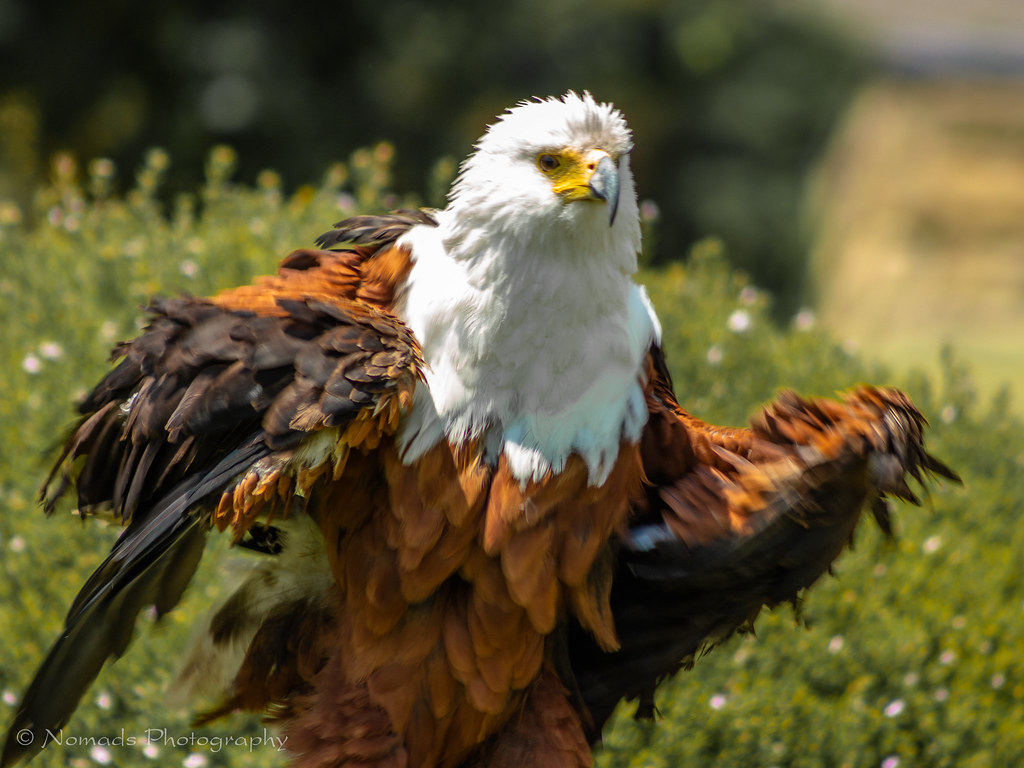
Flurry

Eject

The vivid black-and-white markings of the African sacred ibis certainly ensure that this bird stands in stark contrast to the greens, browns and blues of the South African landscapes. They have the same silhouette as their hadeda relatives but are undoubtedly set apart by their plumage. The sacred ibis’ body is almost completely white, with black feathers on its rump. The wings are edged with a black outline, which is only really visible when the birds extend their wings in flight. These wings also have some bare areas, in which the pink skin shows, both on the top and on the bottom. The neck and head are bald and black, as are the legs and feet. A long curved beak gives the bird a dramatic appearance. Young birds have a smaller beak and their white plumage still looks a little dirty, in comparison with the adults. In addition, they retain some feathers on their necks.

Info source: https://www.sa-venues.com/wildlife/birds_sacred_ibis.php

=========

The photo was taken during June 2017 at De Kleine Serengeti, Dinokeng, Gauteng, South Africa.

Eject

Crusted

During the heat of the day, rhinos will rest up in shade or find a mud wallow. The mud not only cools them down but protects the skin against parasites and the sun. Rhinos tend to move around more during the night when it is cooler and more bearable. They will also drink water whenever available. Rhinos sleep standing up or lying down and can sleep up to 8 hours a day at intervals. They can be found dozing under a tree during a hot day, but when they take a deep sleep, they lie down with their feet curled up slightly to the one side. They sleep very deeply and can easily be approached. These mammals are easily recognised by their prehistoric features and the horns on their forehead. Rhinos are bold and have been seen to graze right next to Lions, with the Lions being equally unfazed. Poachers are greatly responsible for the decreasing Rhino population.
Info source: http://www.krugerpark.co.za/faq-on-rhino.html
=========
The photo was taken during September 2017 near Malelane Gate, Kruger National Park, Mpumalanga, South Africa.

Crusted