Solo

The herons are long-legged freshwater and coastal birds, with 64 recognised species, some of which are referred to as egrets or bitterns rather than herons. Although herons resemble birds in some other families, such as the storks, ibises, spoonbills, and cranes, they differ from these in flying with their necks retracted, not outstretched. They are also one of the bird groups that have powder down. Some members of this group nest colonially in trees, while others, notably the bitterns, use reed beds. The herons are medium- to large-sized birds with long legs and necks. The necks are able to kink in an S-shape, due to the modified shape of the cervical vertebrae, of which they have 20–21. The neck is able to retract and extend and is retracted during flight, unlike most other long-necked birds. The neck is longer in the day herons than the night herons and bitterns. The legs are long and strong and in almost every species are unfeathered from the lower part of the tibia (the exception is the zigzag heron). In flight, the legs and feet are held backwards. The feet of herons have long, thin toes, with three forward-pointing ones and one pointing backwards.
Info source: https://en.wikipedia.org/wiki/Heron

Solo

Scarlet

The Southern Red Bishop is a common and widespread resident and local nomad in marshy grassland, savanna and fields, usually associated with water. They favour breeding in reed beds, and sometimes also in crops. They are highly gregarious and sedentary, and feeds, roosts and breed in flocks. Their distribution is from Angola, Uganda and Kenya, south to the whole of Southern Africa; mainly near perennial water and less common in the dry west. Locally common to abundant, the females outnumber males at a ratio of 3 to 2. Longevity is 12 years. Their general habitat is open grassland, marshes and cultivated areas, typically with close access to perennial water. They are gregarious year-round, form large flocks during the non-breeding season, often with other granivores, and roost in reed beds. It regularly drinks water by sipping, then tips the bill to swallow.

Scarlet

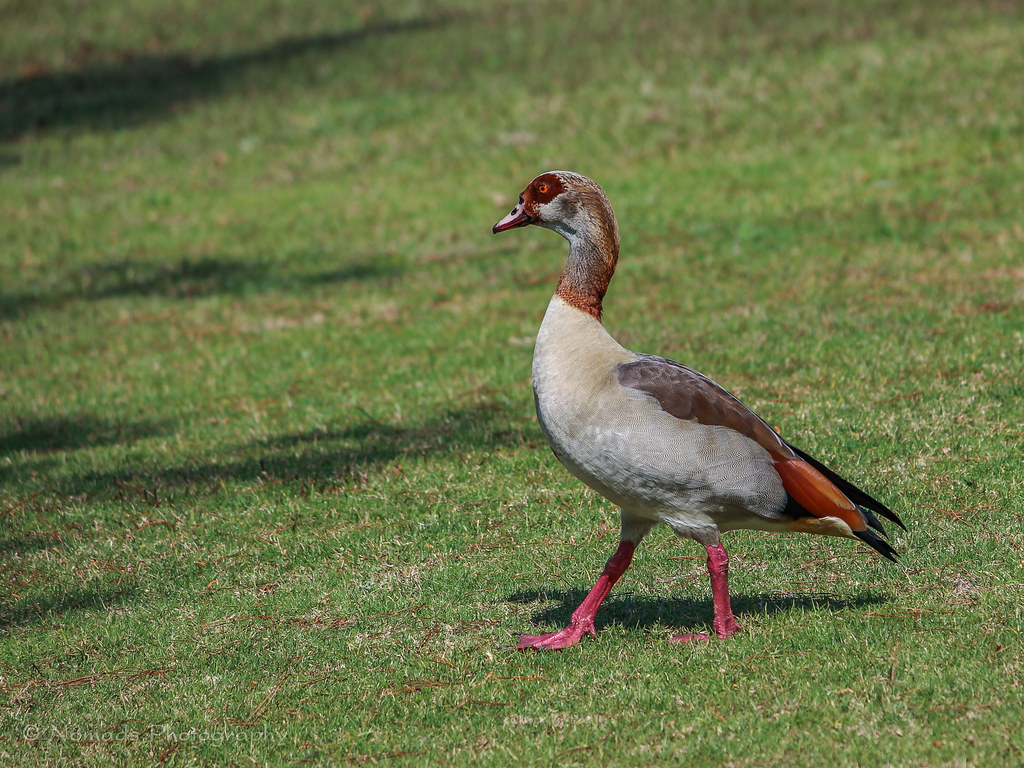
Strut

The beauty of the Egyptian goose is sometimes taken for granted, thanks to its proliferation all over South Africa, and stretching right up to the north of the African continent. It is endemic to the Nile Valley and the entire area south of the Sahara Desert. The Egyptian Goose is related to the shelduck and is a cross between a duck and a goose. The Egyptian goose has vivid markings that are striking and impressive. In fact, they were considered to be holy by the Egyptians, who often included them in works of art due to their undeniable beauty. This bird is pale brown and grey, with rich brown or chestnut markings around the eyes, around the neck (resembling a collar), on a portion of the wings, and under the otherwise black tail. In stark contrast, there are crisp white markings on the wings, complemented by an intense emerald on the secondary feathers of the males. There is also a well-defined brown patch right in the centre of the chest. The female of the species is slightly smaller than her male counterparts. Apart from this, there are few to no clear differences between the sexes.

Strut