Contact

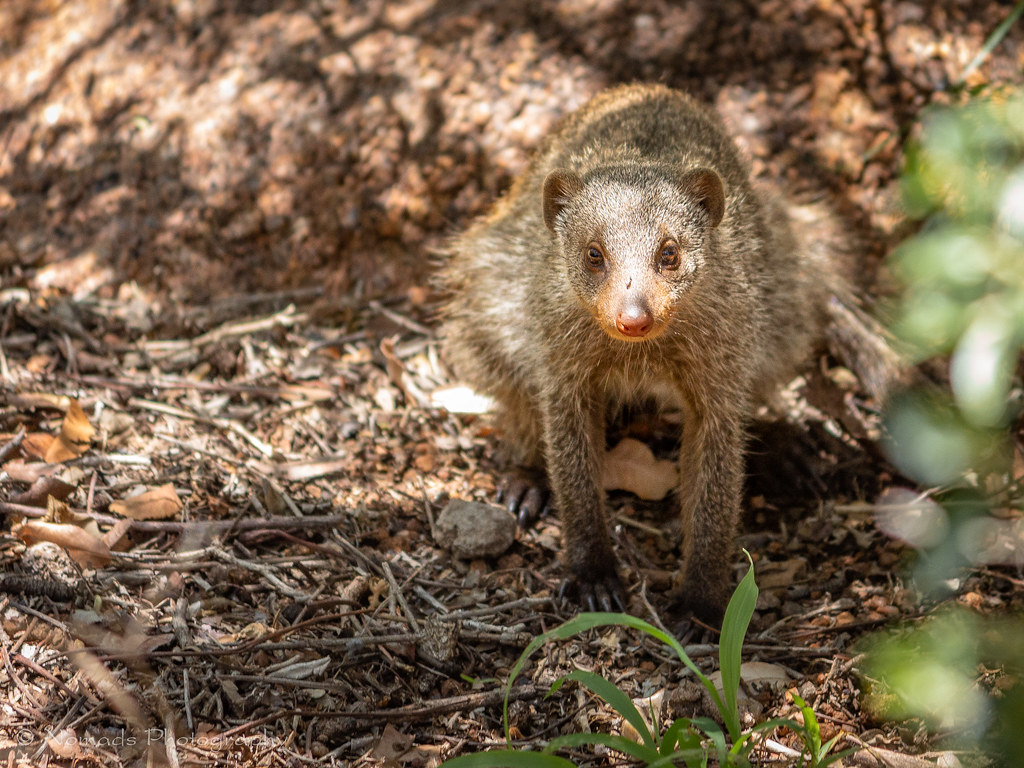
The banded mongoose is stocky and sturdy with a tail that is bushy and is practically as long as its body. Its grey-brown coat is thick and is characterised by bold black or dark brown stripes that run horizontally across the back. Banded mongooses that live in wetter conditions tend to be darker and even bigger than those occupying dryer areas. The underside of the animal is slightly lighter than the upper side, while the legs and the snout are darker. It has a large head with small, broad ears, and its limbs are short and strong. The sharp, strong claws are an important feature that allows them to search and dig for food.
Info source: https://www.sa-venues.com/wildlife/wildlife_banded_mongoose.php
=========
The photo was taken during January 2016 at Mabula Private Game Reserve, Rooiberg, Bela-Bela, Limpopo, South Africa.
Contact

Annoyed

The greater kudu of South Africa has tawny-brown to grey-brown coats with distinctive white stripes running down on its flanks. They have a white V-shaped band across the eyes and forehead with white spots on their cheeks. There are strong physical differences between males and females. The males grow long, spiral horns that can reach up to 1,8 m in length. The kudu bull’s horns reach full length at the age of six years old, and males are significantly larger than females. Bulls can weigh as much as 300 kg with a shoulder height of 1.4 m and cows weigh 210 kg with a shoulder height of 1.25 m. Kudu have long manes of hair that run on its back from head to tail and along the lower neck to the underbelly. The kudu is a browser and feeds on a variety of leaves of trees and shrubs indigenous to South Africa. It also feeds on various fruits, pods, forbs and creepers during different seasons. The kudu is also known to eat South African succulents such as spekboom and aloes. For male kudu, the rutting season occurs between April and May in South Africa. Newborn calves aged 4-6 weeks old are hidden away and nursed by their mothers who visit. Female kudus and their offspring form small groups of four to ten. Breeding throughout the year is not uncommon. A kudu herd tends to split up into two sub-groups. Young females remain with their mothers, while sexually mature males around the age of two years old form bachelor groups. Kudu males will join the female herds during mating season. No territorial spacing exists amongst bulls, but as they show age in their physical appearance, they have size-graded dominant hierarchies.
Info source: http://southafrica.co.za/kudu.html
=========
The photo was taken during September 2017 near Lower Sabie, Kruger National Park, Mpumalanga, South Africa.

Annoyed

Timid

The bushbuck is closely related to the nyala and the kudu. Rams are graceful in appearance with a dark greyish-brown fur, white spots on the flanks and white socks. Ewes are smaller and lighter in colour than the rams, with more distinct stripes and spots. On the ears, legs, tail, chin and neck, both sexes have geometrically shaped white patches and a white band at the base of the neck. The markings on rams become prominent in their displays of arching their backs, slowly circling one another in a tense, high-stepping gait. This is done in order to maintain the strict age-based hierarchy of dominance amongst the rams, showing that fighting would be unnecessary. Bushbucks are most active during the early morning and part of the night. In the case of being alarmed, they can react by sinking to the ground and lying flat, may leap away or bark hoarsely. When surprised in the open, they stand dead still or slowly walk to the nearest cover. Most of their day is spent grazing and standing. They are the only non-territorial and solitary African antelope. Ewes prefer to limit engagement with their young to no more than a few hours a day, and adult rams actively avoid eye contact with one another. Neither rams nor ewes defend their home ranges, often overlapping with the home ranges of other bushbuck.
Info source: http://southafrica.co.za/bushbuck.html
=========
The photo was taken during September 2017 at Tshokwane Picnic Spot, Kruger National Park Mpumalanga, South Africa.

Timid