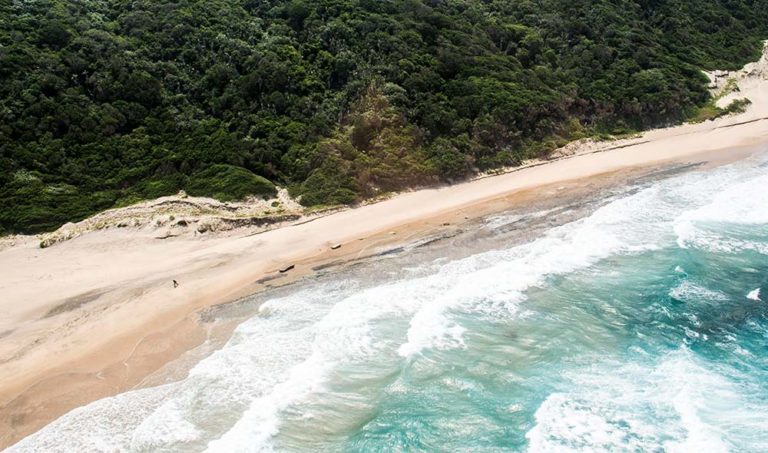
Rugged
Plettenberg Bay hosts one of the largest seagull breeding colonies along the South African coast at the mouth of the Keurbooms River, named after the indigenous keurboom tree. There are many pelagic birds in the area as well as the endangered African oystercatcher which live along the shores. The bay falls within the Agulhas Bank ecoregion (bioregion), specifically within the Agulhas inshore ecozone. There has been a long history of sport fishing from the rocks, ski boats launched from Central Beach, or in Keurbooms estuary. The sea life activity both surface and sub-surface varies considerably as either deep water upwelling brings cold water into the Bay, or warm water eddies over from the Agulhas Indian Ocean current offshore. A distinctive flower-shaped sea shell called a pansy shell is endemic to this part of the coast, and is used as the symbol representing the town. Looking for these shells on the beach at low tide is a popular activity amongst visitors and locals alike.
Info source: https://en.wikipedia.org/wiki/Plettenberg_Bay
The photo was taken during October 2016 at Beacon Isle Resort, Plettenberg Bay, Western Cape, South Africa.