Fan

Flapping of the ears helps to cool an elephant in two ways. In addition to enabling the ears to act as a fan and move air over the rest of the elephant’s body, flapping also cools the blood as it circulates through the veins in the ears. As the cooler blood re-circulates through the elephant’s body, the animal’s core temperature will decrease several degrees.
Info source URL: https://elephantconservation.org/elephants/just-for-kids/
=========
The photo was taken during September 2017 near Tshokwane Picnic Site, Kruger National Park, Mpumalanga, South Africa.
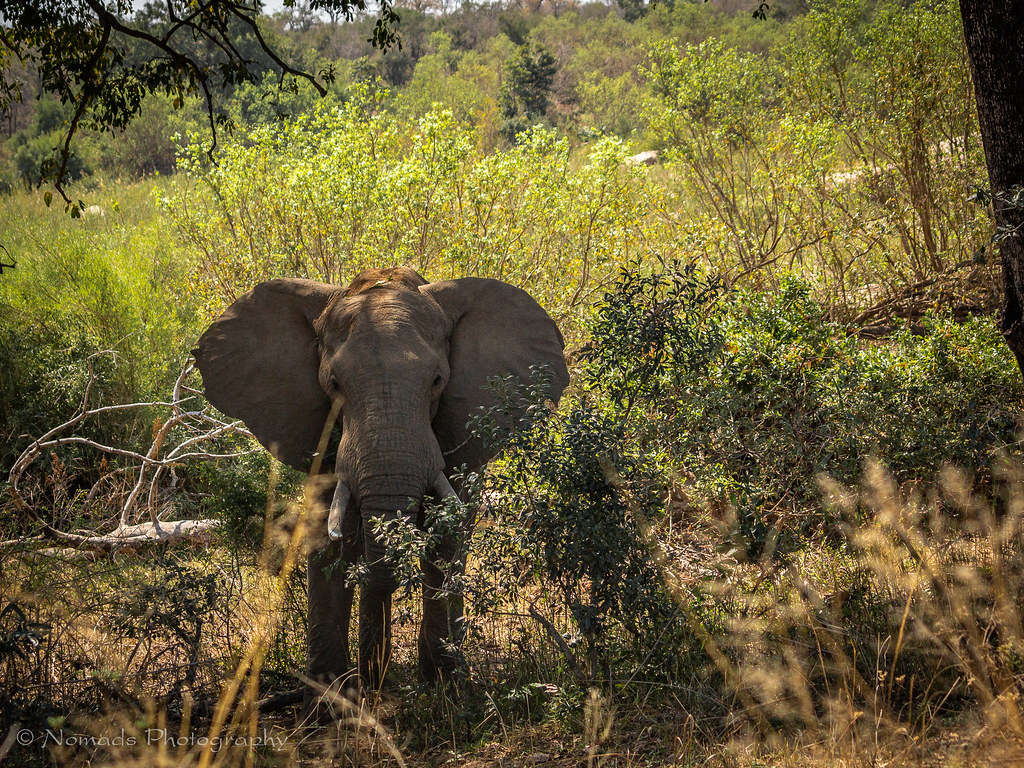
Fan

Peek

The King Cheetah, also known as Cooper’s Cheetah, was once thought to be a separate sub-species. But it is actually an African Cheetah exhibiting a rare fur pattern mutation. A recessive gene must be inherited from both parents in order for this “blotchy” pattern to appear. First discovered in Zimbabwe in 1926, this very rare animal has been seen in the wild only 6 times. It has been known to exist in Zimbabwe, Botswana and in the northern part of South Africa’s Transvaal province. The De Wildt Cheetah Research Centre in South Africa specializes in breeding this cat in captivity.
=========
The photo was taken during October 2017 at Ann van Dyk Cheetah Centre, De Wildt, Pretoria, South Africa.
Info source URL: http://www.cheetahspot.com/king.php

Peek

Hidden

The Kurrichane thrush is 21 to 23 cm (8.3–9.1 in) long and weighs around 46–82 g (1.6–2.9 oz). The head, upperparts and breast are grey, and the belly is whitish with orange flanks. The throat is white with black streaks on the side. The bill is orange, tending to a paler yellow at the base. The legs tend to vary in colour. Both sexes are alike.
Info source URL: https://en.wikipedia.org/wiki/Kurrichane_thrush
=========
The photo was taken during July 2017 in Rietvlei Nature Reserve, Pretoria, Gauteng, South Africa.

Hidden