Contact

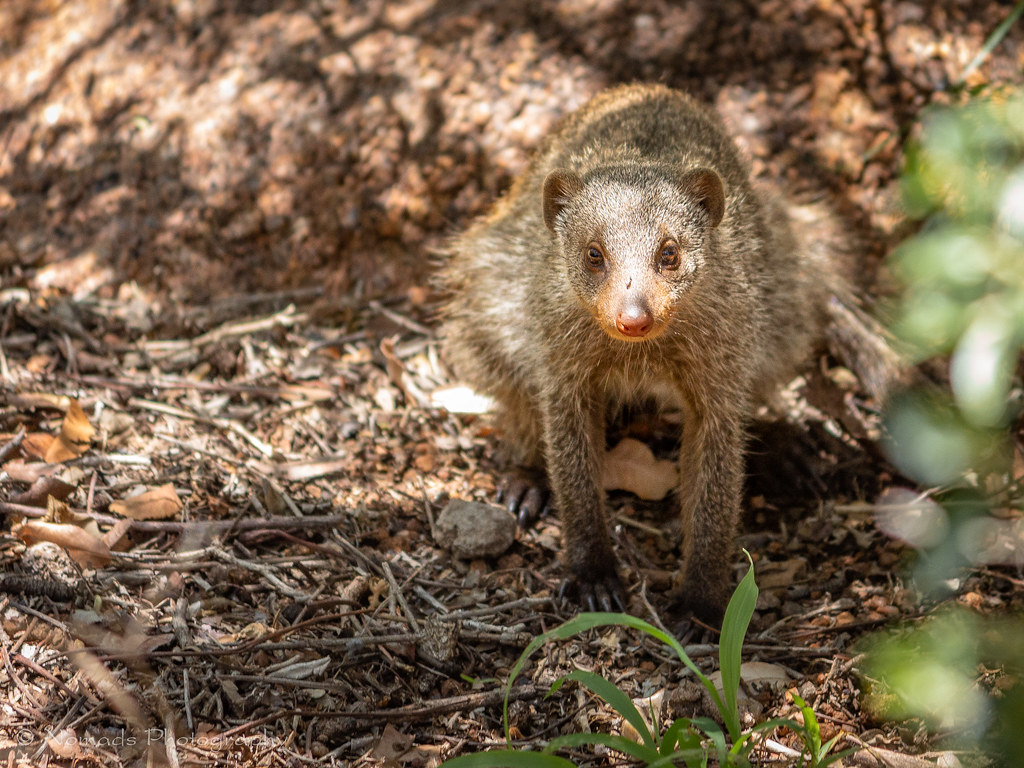
The banded mongoose is stocky and sturdy with a tail that is bushy and is practically as long as its body. Its grey-brown coat is thick and is characterised by bold black or dark brown stripes that run horizontally across the back. Banded mongooses that live in wetter conditions tend to be darker and even bigger than those occupying dryer areas. The underside of the animal is slightly lighter than the upper side, while the legs and the snout are darker. It has a large head with small, broad ears, and its limbs are short and strong. The sharp, strong claws are an important feature that allows them to search and dig for food.
Info source: https://www.sa-venues.com/wildlife/wildlife_banded_mongoose.php
=========
The photo was taken during January 2016 at Mabula Private Game Reserve, Rooiberg, Bela-Bela, Limpopo, South Africa.
Contact

Fluff

Burchell’s zebra, which is also known as the plains zebra, has black and white stripes all over its body with only a few or fading stripes on the legs. Each zebra has unique stripes that can be used as an identification character to distinguish between individuals – similar to fingerprints in humans. The stripes on the sides run down and join under the belly. Burchell’s zebra can be mistaken for the mountain zebra, but the stripes on the legs (fading stripes in Burchell’s zebra vs. clear stripes on mountain zebra) and belly are distinct (in the mountain zebra, the belly is all white with no stripes).
Info source: https://www.sanbi.org/animal-of-the-week/burchells-zebra/
=========
The photo was taken during January 2015 at Mabula Private Game Reserve, Rooiberg, Bela-Bela, South Africa.

Fluff

Duet

The common tsessebe is a close relative of the bontebok. It is somewhat comical in appearance; with high, sloped shoulders that descend to a small rump that does not look particularly strong. In fact, its entire body looks more clumsy than agile. However, when threatened, this has proven to be one of the fastest antelope in the bushveld of Africa. They can reach a running speed of up to 80 kilometres per hour. This is no mean feat when one considers that its peers are the mighty wildebeest and the elegant springbok. The common tsessebe is brown (adult males are darker than juveniles and female adults) with white or darker brown markings. The long, slender legs and chest are black, and there is a black line running from their forehead to the tip of their nose. The belly is white, and their muzzles are narrow and elongated. For the tsessebe, the horns play an important role in determining their age and in establishing dominance (by means of horning the ground). These horns are S-shaped and ringed. They wear down over the years, so older animals can be distinguished by their well-worn horns.
Info source: https://www.sa-venues.com/wildlife/wildlife_tsessebe.php
=========
The photo was taken during February 2019 at Mabula Private Game Reserve, Rooiberg, Bela-Bela, Limpopo, South Africa.

Duet